Behavior in Context: The Missing Link in Leadership, Hiring, and Team Performance

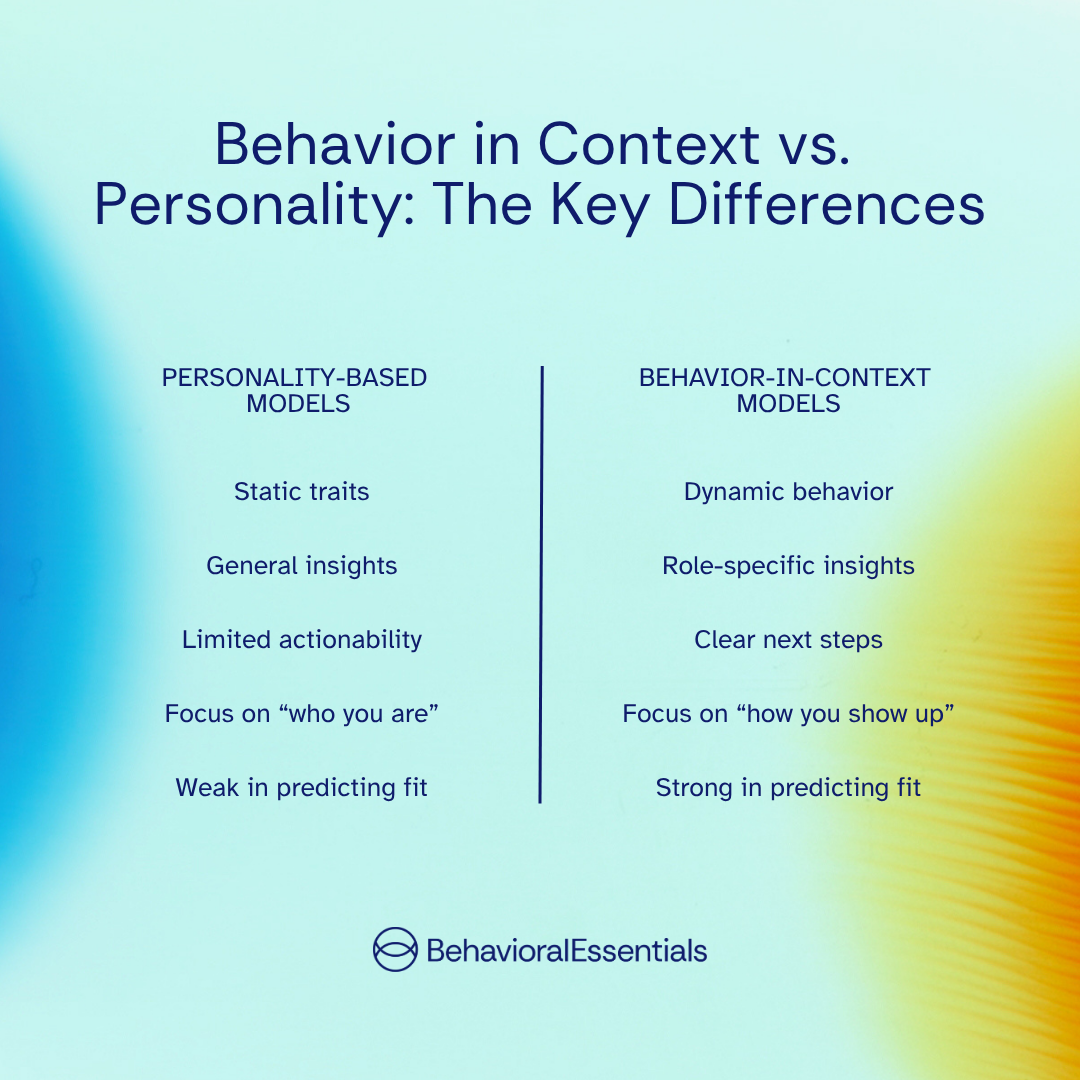
Most personality assessments tell you who someone is. Very few tell you how they’ll actually behave in your organization. That’s a problem. Personality is relatively stable, while behavior isn’t—it’s shaped by context. And if you’re not measuring behavior in context, you’re making hiring, leadership, and team decisions with incomplete data. This is why organizations are shifting toward behavioral assessment for teams, hiring, and leadership development—and why “behavior in context” is becoming the new standard.
The Problem: Why Traditional Personality Assessments Fall Short
If you’ve ever used a personality assessment for hiring or leadership development, you’ve probably seen this:
- A candidate looks great on paper
- Their personality traits appear aligned
- But once they’re in the role… something doesn’t click
The most common reason for this misalignment has to do with the inherent limitations of the most commonly used personality assessments.
Most tools measure static personality traits like:
- Extraversion
- Conscientiousness
- Agreeableness
Yet static traits alone cannot predict a person’s behavior within a specific environment. And that’s exactly where businesses operate.
These assessments can’t tell you what type of manager they need, how they best receive constructive feedback, or the conditions and systems that will foster their creativity.
This is why we need to look at behavior in context when assessing a current employee or potential candidate’s true potential.
What Is “Behavior in Context”?
Assessing behavior in context means understanding: How someone’s natural tendencies interact with the specific demands, culture, and pressures of your organization.
Instead of asking: “Is this person a strong leader?”
You ask, “How will this person lead in this company, with this team, under this pressure?”
That’s a fundamentally different question, and a substantially more useful one.
The Science Behind Behavior in Context
Behavior-in-context frameworks are grounded in decades of behavioral science and interactionist psychology.
Unlike traditional personality-only models, behavior-in-context models examine how individual needs interact with environmental demands to shape real-world behavior.
This approach is rooted in Henry Murray’s needs-press theory and supported by decades of psychometric research behind the Adjective Check List (ACL), the scientific foundation underlying the E3 Behavioral Assessment.
Download the Whitepaper: The Behavioral Science Behind the E3 Behavioral Assessment
Why Behavior Changes (And Why That Matters for Business)
Most personality assessments focus on stable traits.
But organizations don’t operate in static conditions. They operate in dynamic environments shaped by pressure, expectations, team dynamics, leadership styles, and organizational culture.
That’s why understanding behavior is often far more valuable than understanding personality alone.
Personality reflects underlying tendencies and predispositions that tend to remain relatively stable over time. Behavior, however, is adaptive. It changes based on context, awareness, incentives, pressure, relationships, and environmental demands.
In other words, personality may influence behavior, but it does not determine behavior.
That distinction matters because behavior is what organizations actually experience every day:
- How someone communicates under pressure
- How they respond to feedback
- How they lead a team
- How they handle conflict
- How they prioritize
- How they adapt as expectations change
And unlike personality traits, behavior can be observed, coached, adjusted, and developed over time.
An Example of Personality vs. Behavior
Take an extraverted leader who naturally enjoys being the center of attention and tends to dominate meetings.
Their underlying tendency toward assertiveness and visibility may remain relatively stable. But their behavior can still evolve significantly with greater awareness and intentionality.
With coaching and feedback, they may learn to:
- Pause before responding
- Ask more open-ended questions
- Intentionally create space for quieter team members
- Speak later in meetings rather than first
Their internal tendency toward engagement may not disappear. But their behavior changes because the context demands a different leadership approach.
That’s the difference between personality and behavior.
And it’s why organizations that focus only on personality often miss the much more important question: How will this person actually behave in this environment?
What Behavior Change Actually Looks Like
One senior executive we worked with scored extremely high in exhibition on the E3 Behavioral Assessment.
In meetings, he naturally dominated conversations because he always needed to be the center of attention.
He was highly intelligent and a capable leader, both strengths which helped him rise into leadership in the first place.
But over time, those strengths began creating unintended consequences:
- Quieter voices stopped contributing
- Conversations narrowed
- Team participation declined
So instead of trying to change his personality, we focused on one specific behavioral adjustment.
For the first 15 minutes of meetings, he committed to staying silent.
The team even created small “Shut Up” cards they could play if he slipped back into old habits.
Because of this, other team members began speaking up, collaboration improved, and the leader gained a greater awareness of how much space he had been taking up unintentionally.
The goal was never to change who he was. It was to help him behave more effectively in context.
That’s the difference between personality and behavior.
The Cost of Ignoring Context
When organizations rely only on personality or surface-level assessments, they miss a whole host of factors related to interactional context:
1. Poor Job Fit
Even high performers can fail if the environment doesn’t match how they operate.
2. Leadership Blindspots
Leaders often overuse strengths that don’t fit the situation, creating friction instead of results.
3. Team Misalignment
Two “great” individuals can still clash if their behaviors don’t align in context.
4. Ineffective Coaching
You can’t coach what you don’t understand, and personality types don’t tell you what to change.
Understanding how the environment shapes behavior is key to making hiring, leadership, and team decisions that are in alignment with human needs and organizational goals.
Where Behavior in Context Changes the Game
1. Data-Driven Hiring
Using a behavioral assessment for hiring that accounts for context allows you to:
- Predict how candidates will perform in their specific role
- Assess team and culture alignment
- Improve retention
- Identify leadership blindspots
- Reduce costly hiring mistakes
This is the difference between:
“They look like a good fit” vs. “They are a good fit for this role and this culture”
2. Leadership Development That Actually Works
Most leadership assessment tools can only tell leaders what their disposition is, abstracted from context.
But behavior-in-context frameworks show:
- Where their leadership approach works
- Where it breaks down
- What to adjust in real situations
That’s how you uncover:
- Leadership blindspots
- Overused strengths
- Gaps in execution vs. vision
3. Stronger Team Alignment
A team behavioral assessment grounded in context helps teams:
- Understand how each person shows up under pressure
- Improve communication
- Reduce conflict
- Align around how work actually gets done
This leads directly to:
- Better collaboration
- Faster decision-making
- More consistent performance
4. Smarter Organizational Decisions
When you understand behavior in context, you can:
- Build better behavioral benchmarks for roles
- Design teams more intentionally
- Improve culture alignment
- Make faster, more confident leadership decisions
Why This Matters Now (More Than Ever)
Organizations today are dealing with:
- Faster decision cycles
- More complex team structures
- Higher leadership expectations
- Increased pressure on hiring accuracy
That means the margin for error is smaller than ever before.
It’s time to move past outdated assessment models to build successful teams.
The Future: Behavioral Assessment for Organizations
The shift is underway as companies are moving toward:
- Behavioral assessment software that goes beyond personality
- Data-driven hiring models
- Executive coaching grounded in real behavior, not theory
- Workplace behavioral assessment tools that scale across teams
Because at the end of the day: The organizations that understand human behavior best… perform the best.
Want to Go Deeper?
Download our technical whitepaper: The Behavioral Science Behind the E3 Behavioral Assessment
Learn more about:
- Needs-press theory
- Behavior-in-context frameworks
- Behavioral benchmarking
- The science behind the E3 Behavioral Assessment
- Applied organizational validity
Final Thought
If you want better outcomes in hiring, leadership, and team performance, you need data that’s actually relevant to specific situations.
And that starts with understanding behavior in context.
What is a behavioral assessment for teams?

How is behavior different from personality?
What is the best behavioral assessment for hiring?
How do behavioral assessments improve leadership development?
Why do candidates who “look great on paper” fail?
What is a workplace behavioral assessment?